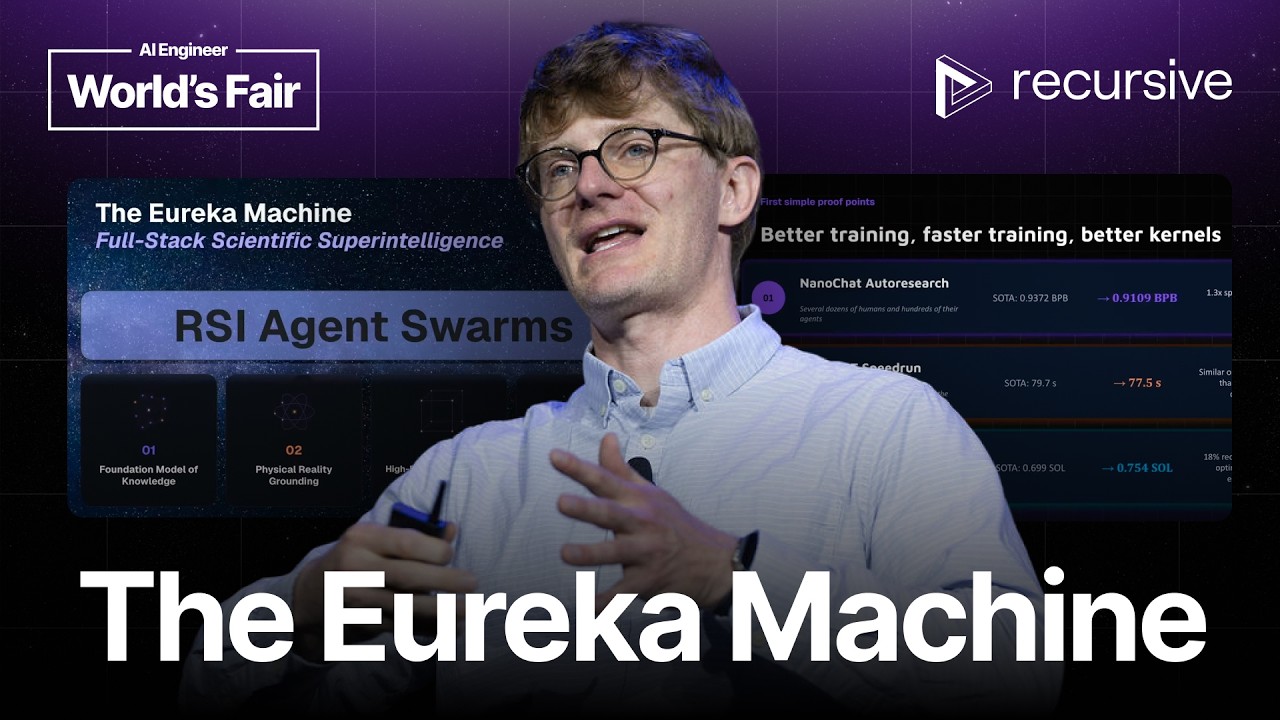
Ever wonder how AI could write the next breakthrough paper on its own? Richard Socher believes we’re just starting the journey.
The Simple Version
Imagine a tireless team of AI agents that test ideas, spot flaws, and fix them — again and again — without human bottlenecks.
How It Actually Works
Recursive Self‑Improvement
An AI system rewrites its own code, runs experiments, and uses the better results to train the next iteration.
Architecture Search
Instead of hand‑crafting neural nets, an automated loop explores many designs and picks the most efficient.
CUDA Kernel Optimization
Specialized GPU kernels are hand‑tuned for speed; Socher’s team built an auto‑search that discovers faster kernels.
Technical Deep Dive
They start with a baseline model scoring 78% accuracy on a benchmark.
Using a reinforcement‑learning loop, the system iterates 12 times, lifting accuracy to 86% — a clear jump over naive baselines.
The architecture search replaces manual layer selection with a neural architecture search (NAS) that evaluates candidates on a validation set, saving weeks of engineer time.
For CUDA kernels, they employed a genetic algorithm that mutates kernel templates, benchmarking each variant on a GPU; the best variant achieved a 15% speedup on matrix multiplication.
Why This Matters
If AI can automate research loops, entire fields like medicine or climate science could accelerate breakthroughs dramatically.
This would democratize innovation, letting smaller labs compete with mega‑corporations that currently own the research pipelines.
Beyond speed, the approach could uncover solutions humans might never consider, expanding the frontier of what’s scientifically possible.
Key Takeaways
- AI agents can run a full “try‑fail‑fix” cycle across scientific domains.
- Recursive self‑improvement shows measurable gains in model accuracy.
- Automated architecture search replaces tedious manual tuning.
- Even low‑level GPU kernels can be discovered automatically, delivering real speedups.
- The vision hinges on re‑imagining search, browsers, and GPU tooling.
- Progress is early but directional; the community is invited to contribute.
- Success could compress scientific timelines the way the internet compressed information.