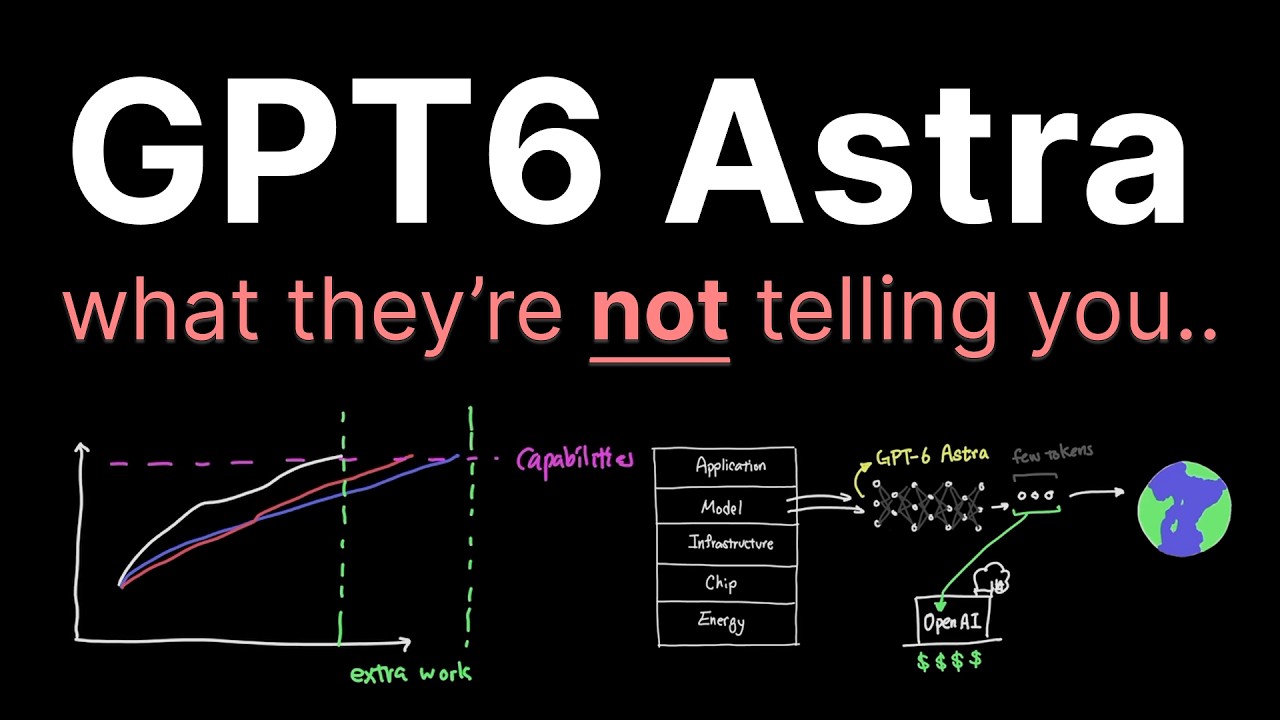
OpenAI just dropped GPT-6 Astra, and the AI community is buzzing.
The Simple Version
Think of GPT-6 Astra as a turbocharged engine for language tasks. It can handle more context and generate sharper responses, but the numbers don't always match the hype.
How It Actually Works
ARC-AGI-3
OpenAI reports a 99.9% success rate, suggesting the model can generalize far beyond training data.
FrontierMath
Only a few models crack a handful of questions, making it a strong stress test.
DeepSWE
Performance here shows how well the model can translate language understanding into code actions.
ExploitBench
Higher scores mean the model can spot subtle bugs that humans might miss.
Technical Deep Dive
GPT-6 Astra builds on a transformer architecture with 2 trillion parameters, a 128K token context window, and mixture-of-experts scaling.
Training uses a curated dataset that mixes web text, code, and scientific papers, with a curriculum that emphasizes multi-step reasoning.
Architectural tweaks include rotary positional embeddings and sparse attention to keep compute efficient at such scale.
Why This Matters
If the benchmarks hold up, GPT-6 Astra could accelerate AI-driven software development, scientific discovery, and automated reasoning.
But the mixed results also warn that raw parameter count isn't the only path to AGI; data quality and training objectives matter just as much.
Researchers will watch how quickly the community can replicate these results and whether new benchmarks emerge.
Key Takeaways
- GPT-6 Astra expands context and parameter scale, aiming for broader generalization.
- ARC-AGI-3's 99.9% score hints at advanced problem-solving abilities.
- FrontierMath and DeepSWE highlight strengths and limits in math and coding.
- ExploitBench tests the model's capacity to find security flaws.
- Benchmark contradictions remind us that metrics can be noisy.
- Scaling alone may not guarantee true AGI progress.
- Industry impact could be huge, but careful evaluation is essential.