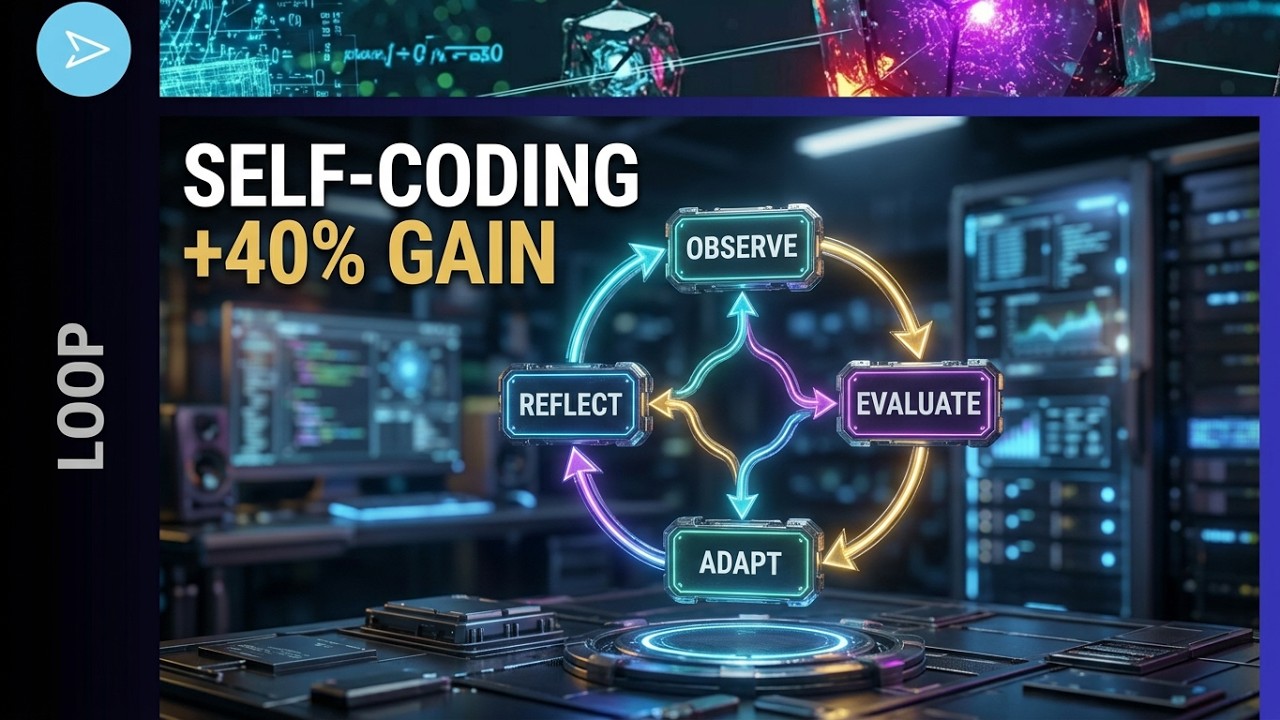
Ever wondered if AI can write its own control loops?
This video breaks down a groundbreaking paper where autonomous agents design their own loop architectures.
The Simple Version
Think of a loop as a recipe that tells an AI what steps to repeat. The paper shows agents that can cook up their own recipes without human help.
How It Actually Works
Reasoning‑Driven Search
The optimizer is treated as an agent that explores a space of prompts, programs, and ML workflows.
Search uses reasoning steps to evaluate each candidate and pick the best.
Architecture Overview
Agents start with a seed loop, then iteratively refine it by generating sub‑loops, testing performance, and updating the design.
Technical Deep Dive
We dive into the multi‑agent framework where each specialist handles prompt engineering, program synthesis, or workflow optimization.
The system leverages reinforcement learning to reward loops that achieve higher efficiency metrics.
Implementation details include a token‑level search algorithm and a dynamic pruning strategy to keep computation feasible.
Why This Matters
Self‑designing loops could eliminate manual tuning in AI pipelines, cutting development time and boosting adaptability.
Enterprises may soon deploy agents that continuously rewrite their own processing loops for real‑time optimization.
This shift moves AI from static models to living, self‑improving systems.
Key Takeaways
- Agents can code their own loops.
- Reasoning‑driven search explores prompts, programs, and workflows.
- Optimizers act as agents, not just algorithms.
- Technical tricks like pruning keep search efficient.
- Potential to automate AI pipeline tuning.
- Scalable for real‑world production workloads.
- Future AI may be self‑architecting.