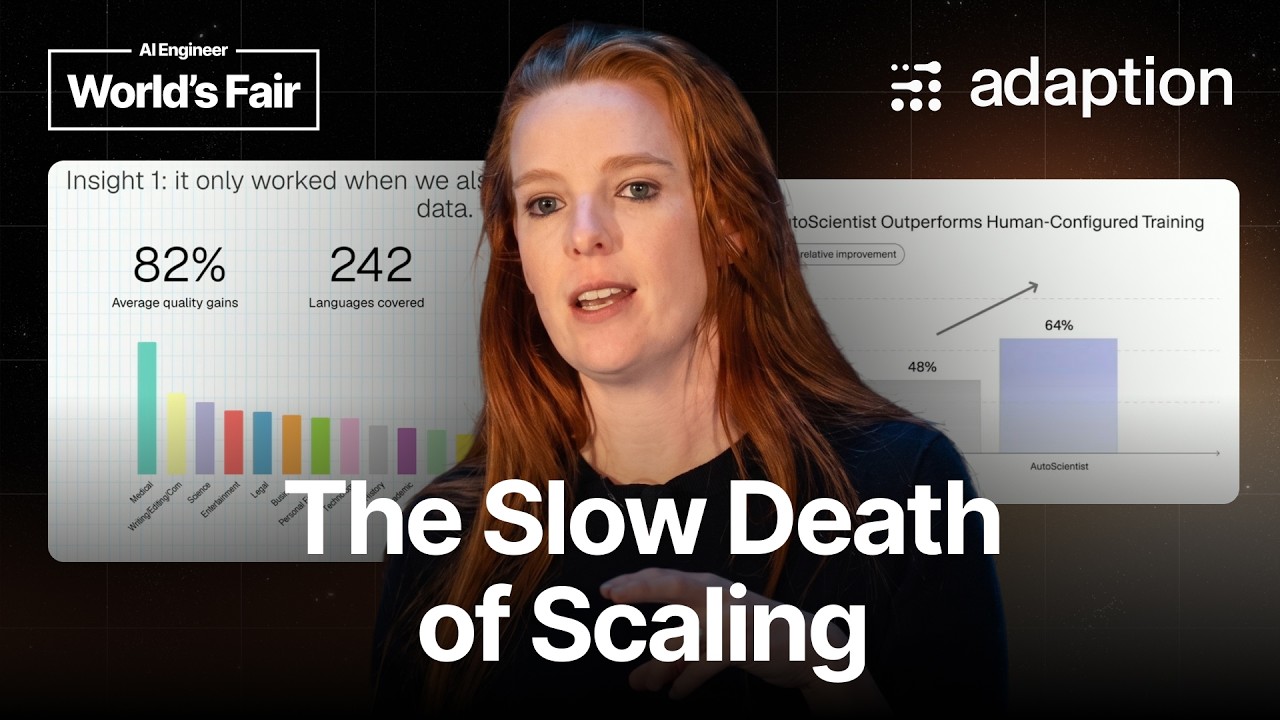
Ever felt locked out of the AI frontier because only a handful of labs hold the keys? Sara Hooker shows how that exclusivity might soon crack open.
The Simple Version
Think of training a massive AI model like planting a garden. You need the right seeds, soil, and water — but you also need to keep checking the plants as they grow.
How It Actually Works
AutoScientist Loops
AutoScientist runs a cycle: generate data, train a model, evaluate performance, adjust parameters, and repeat.
Data‑Model Coupling
Instead of treating data as a fixed input, the system treats data quality as part of the optimization loop.
Beyond Scaling
Win rates hover just above 60% with a modest budget, but lifting that budget lets the system climb higher.
Technical Deep Dive
The architecture explores dense and mixture‑of‑experts designs, searching across model sizes without hard‑coded priors.
Control of data quality alongside model updates forces the agent to internalize cleaning steps, which dramatically improves stability.
Budget constraints act as an early stop; extending them reveals continued performance gains, suggesting untapped potential.
Smaller models now outperform larger ones in specific tasks because the action space includes pruning, routing, and hyperparameter search.
Why This Matters
Democratizing frontier model training means more domains — medicine, law, scientific code — can harness cutting‑edge AI without needing a multi‑million‑dollar lab.
Distributable compute lets researchers in under‑connected regions participate, breaking the monopoly of a few GPU‑rich centers.
When algorithms replace raw GPU hoarding, innovation shifts from hardware scarcity to clever design, opening the field to a broader talent pool.
Key Takeaways
- AutoScientist jointly optimizes data and model, beating human teams.
- Performance improves steadily once budget limits are removed.
- Scaling is no longer the sole driver of breakthroughs.
- Smaller, smarter models can outpace larger, less‑tuned ones.
- The approach lowers the barrier to entry for many industries.
- It shifts the competitive edge from GPUs to algorithms.
- Access to frontier AI could become far more widespread.