Ever wondered how AI can hunt down the perfect piece of evidence to answer your question?
The Simple Version
Think of a RAG system as a librarian that pulls books to answer a question. HyCE‑RAG upgrades the librarian by mapping facts onto a web of connections, so it can pick the right book in a flash.
How It Actually Works
Step 1: Build a Hypergraph
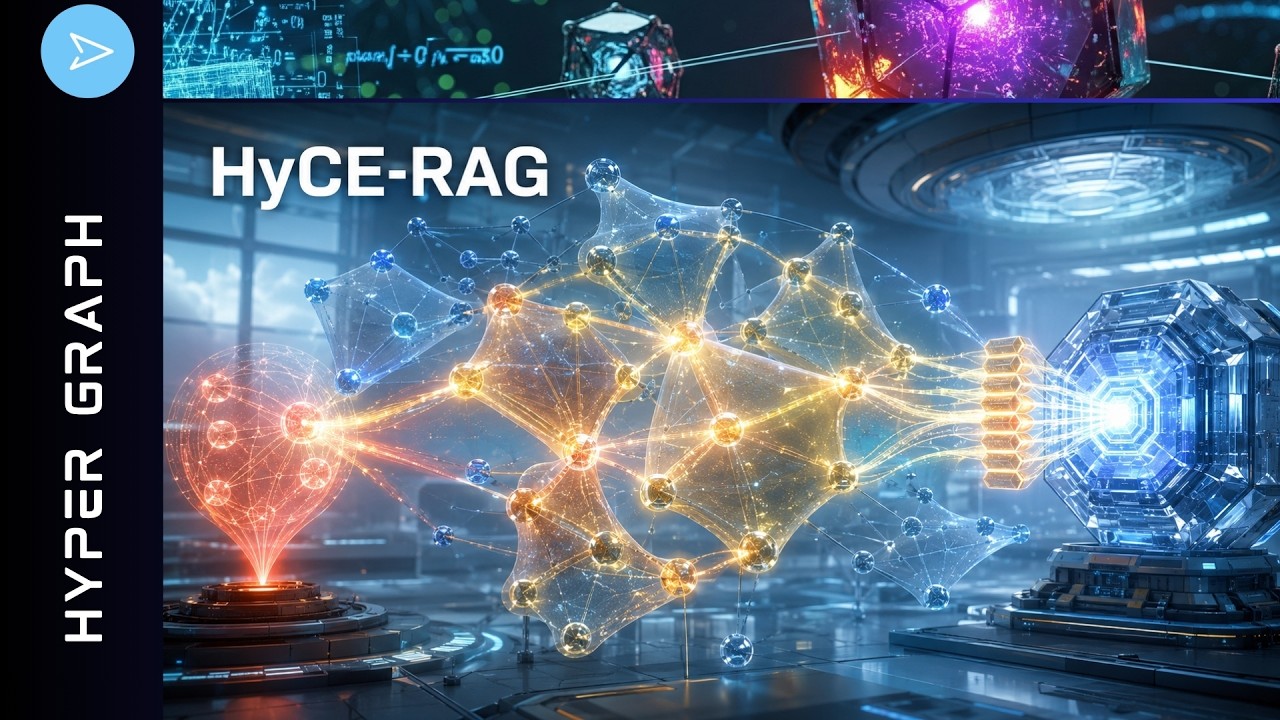
The model first creates a hypergraph where each node holds a piece of knowledge and edges link related concepts.
Step 2: Query‑Conditioned Diffusion
When you ask a question, the system spreads activation from the query across the hypergraph, like ink soaking into a sponge.
Step 3: Evidence Extraction
The activated nodes are filtered to retrieve the most pertinent pieces of evidence for the answer.
Technical Deep Dive
HyCE‑RAG uses a hypergraph convolutional network combined with a diffusion process that is conditioned on the user query embedding.
During inference, a multi‑head attention mechanism propagates probability mass through hyperedges, allowing the model to weigh evidence from multiple related facts simultaneously.
The diffusion is guided by a learnable temperature scalar that controls how quickly relevance spreads, and a sparsity regularizer keeps the final evidence set compact.
Why This Matters
For developers building chatbots or search assistants, HyCE‑RAG reduces hallucination by grounding responses in a tightly connected evidence pool.
Enterprises can deploy it to deliver more accurate answers without expanding model size, saving compute and latency budgets.
Researchers gain a scalable way to incorporate structured knowledge graphs into LLM pipelines, opening doors to richer, domain‑specific AI applications.
Key Takeaways
- HyCE‑RAG spreads query influence through a hypergraph to locate relevant facts.
- Diffusion acts like ink, highlighting the most connected evidence nodes.
- The method improves accuracy while keeping computational cost low.
- It integrates smoothly with existing RAG pipelines.
- Scalable for large knowledge bases and multi‑modal data.
- Reduces hallucinations by grounding answers in verified evidence.
- Opens new avenues for structured knowledge fusion in LLMs.