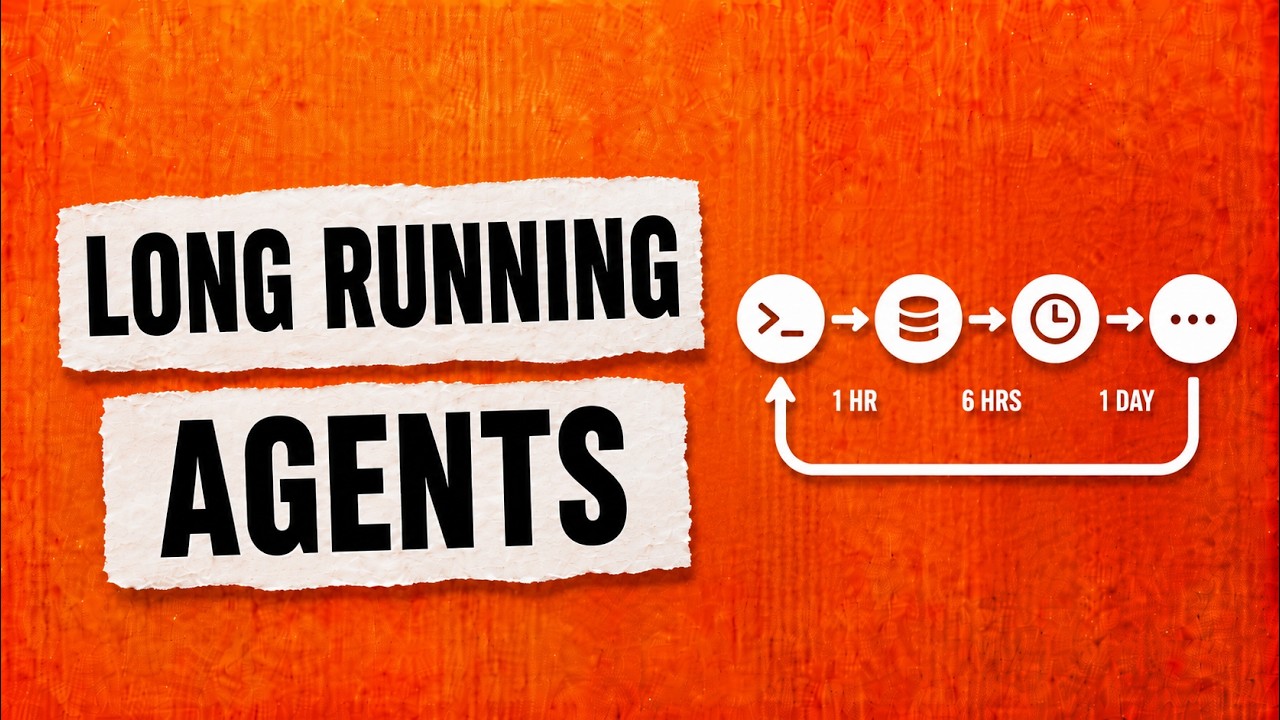
Agents that keep working for hours or days used to feel like chasing a moving target.
The Simple Version
Think of an AI agent as a self‑driving car. You need a clear destination, a co‑pilot to check the route, brakes that actually stop, and a dashboard that tells you when something’s wrong.
How It Actually Works
Goal as Contract
Define the objective in measurable terms, like “complete checkout in under 30 seconds with 99 % accuracy.”
Evaluator as Separate Judge
A second model watches the first and scores outcomes against the contract.
Verifiers Proof Not Claims
Use deterministic checks that verify each step, not just vague assertions.
Outer Loop Control System
The system monitors failures, updates the plan, and retries until the goal is met.
Orchestration Across Roles and Models
Different specialized models handle planning, execution, and evaluation, sharing results to control cost and quality.
Observability Dashboards and Feedback
Live dashboards surface metrics, errors, and context drift, letting you intervene early.
Memory via Session Mining
Store past runs, extract patterns, and turn failures into new rules for future attempts.
Technical Deep Dive
Implement the outer loop using a state machine that cycles through “plan → execute → evaluate → revise.”
Use latitude‑llm’s session_mining API to extract error signatures and auto‑generate verification rules.
Orchestrate with LangChain’s RunnableSequence to route outputs to the appropriate specialist model.
Verifiers can be chained deterministic scripts (e.g., regex checks) followed by a stronger LLM‑based evaluator for edge cases.
Observability is wired to Prometheus metrics, exposing latency, cost, and failure rates in real time.
Why This Matters
Agents that run reliably unlock use cases like automated customer support, long‑form content creation, and multi‑day data pipelines.
Enterprises can reduce manual babysitting, cut operational costs, and iterate faster on AI‑driven products.
Without these components, agents tend to shortcut, hallucinate, or stall, leading to broken user experiences and wasted compute.
Key Takeaways
- Set a clear, measurable goal as a contract.
- Deploy a separate evaluator to judge outcomes.
- Use strict verifiers that combine deterministic checks with strong LLM judgments.
- Implement an outer loop to iterate on failures.
- Orchestrate multiple specialized models to balance cost and quality.
- Leverage observability dashboards for real‑time monitoring.
- Mine past sessions to turn failures into reusable rules.