Ever wonder why a giant cloud AI sometimes fails at basic logic while a smaller local model—with the right setup—can absolutely crush it?
The secret isn't just the size of the model; it's the ecosystem you build around it.
The Simple Version
Most people think an AI is just one big "brain." In reality, a high-performing AI system is a team effort.
Imagine a genius mathematician who is brilliant but incredibly forgetful. If you ask them to do a complex calculation in their head, they might make a silly mistake.
How It Actually Works
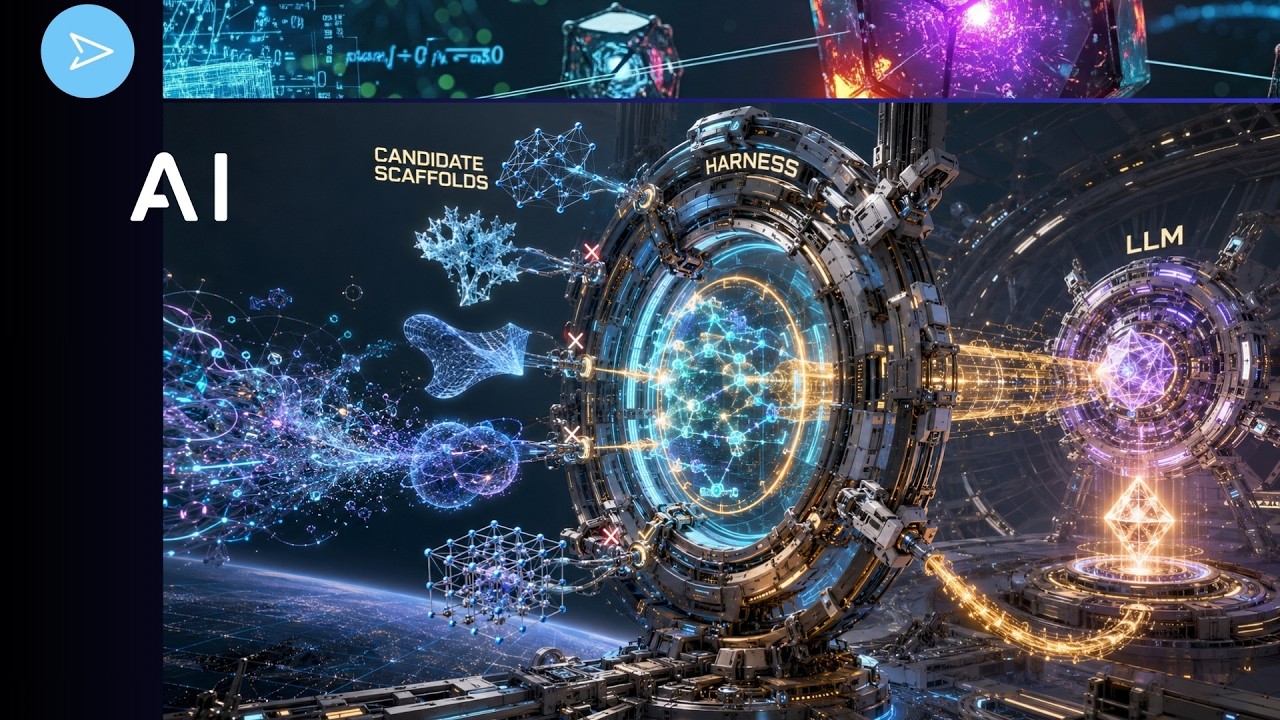
To build a local system that beats the cloud, you need to coordinate three distinct layers.
The LLM Core
This is the open-weights model itself (like Llama or Mistral). It provides the linguistic ability and general knowledge base.
On its own, the core is just a probability engine predicting the next word.
The AI Harness
The harness is the software layer that wraps around the core. It manages how the model is loaded into your RAM and how it interacts with your OS.
Math Scaffolding
Scaffolding consists of external tools—like Python interpreters or specialized logic modules—that the AI can call upon.
Instead of "guessing" the answer to a math problem, the AI uses the scaffold to calculate it precisely.
Technical Deep Dive
The real breakthrough comes from moving Beyond Retrieval. While standard RAG (Retrieval Augmented Generation) simply fetches a document, Analytic Memory actually processes and structures data for reasoning.
By implementing a local scaffold, you are essentially creating a multimodal agent. This agent doesn't just predict text; it orchestrates a workflow between the model's weights and external computational kernels.
For developers, this means optimizing your local compute (like a Mac Mini or high-end PC) to handle the interplay between these layers. The goal is to minimize the latency between the core's request and the scaffold's execution.
Why This Matters
First, it solves the privacy nightmare. Your sensitive data never leaves your local hardware, making it ideal for corporate or personal secrets.
Second, it breaks the dependency on expensive monthly subscriptions. Once you optimize your local scaffold, you have a powerhouse AI that costs nothing to run.
Finally, it proves that architectural efficiency beats raw scale. A small model with a great scaffold is more reliable than a massive model that hallucinates its math.
Key Takeaways
- Model size isn't everything: Architecture and tools matter more than parameter count.
- The Core: Provides the basic intelligence and language skills.
- The Harness: Manages the environment and execution of the model.
- The Scaffolding: Provides the logic, math, and external tools for precision.
- Analytic Memory: Goes beyond simple search to provide actual reasoning capabilities.
- Local Power: Modern consumer hardware is now capable of outperforming cloud models when configured correctly.