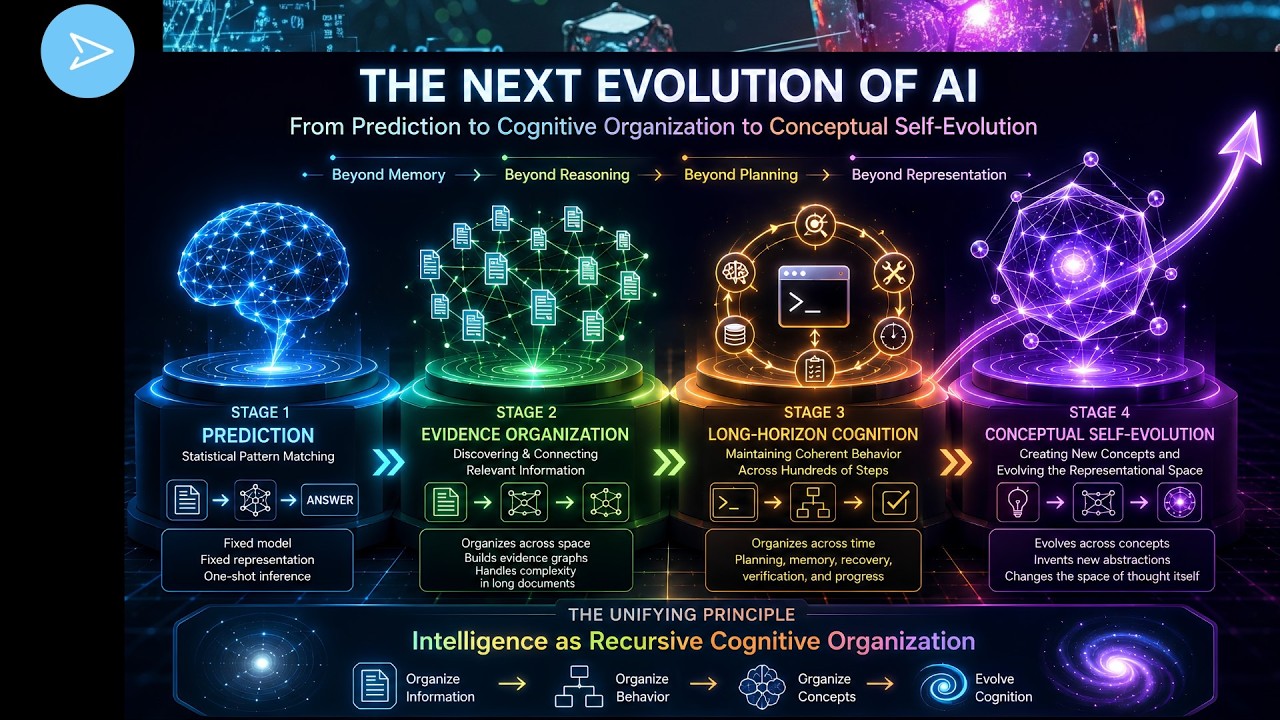
Ever wonder if AI is about to rewrite the rules of how it thinks?
The Simple Version
Think of today’s AI as a calculator that always answers the same way.
Tomorrow’s AI will be more like a detective that gathers clues, keeps a case file, and updates its own theory when needed.
How It Actually Works
Recursive Cognitive Organization
These papers propose that future models will autonomously organize evidence into graphs.
Long‑Horizon Behavioral Trajectories
The system maintains a chain of actions that span hours or days, not just a single reply.
Evolving Representational Geometry
Instead of a fixed set of concepts, the AI rewires how it represents knowledge as problems change.
Technical Deep Dive
Researchers introduce “evidence graphs” that map related facts and reasoning paths.
They use graph neural networks to update these structures as new data arrives.
Long‑horizon tasks are evaluated with dense reward signals that penalize drift from the original goal.
Open‑ended vocabularies are created via dynamic tokenizers that expand as the model discovers new concepts.
Why This Matters
If AI can self‑organize its cognition, it could solve problems that today require human oversight.
Businesses may see agents that plan projects, adapt strategies, and even write new code without constant prompting.
However, such autonomy also raises safety and alignment challenges that the community must address now.
Key Takeaways
- Frontier AI is moving beyond prediction to self‑directed cognition.
- Evidence graphs let models build and update their own knowledge structures.
- Long‑horizon behavior requires persistent goal representation.
- Representational geometry can evolve to stay relevant.
- Technical progress hinges on graph networks and dynamic vocabularies.
- Real‑world impact includes smarter agents but also new safety concerns.
- Developers should watch these papers for architecture cues and benchmarking ideas.